
East Texas tree problems
Hypoxylon Canker on Oaks in Kilgore, Texas
Short answer
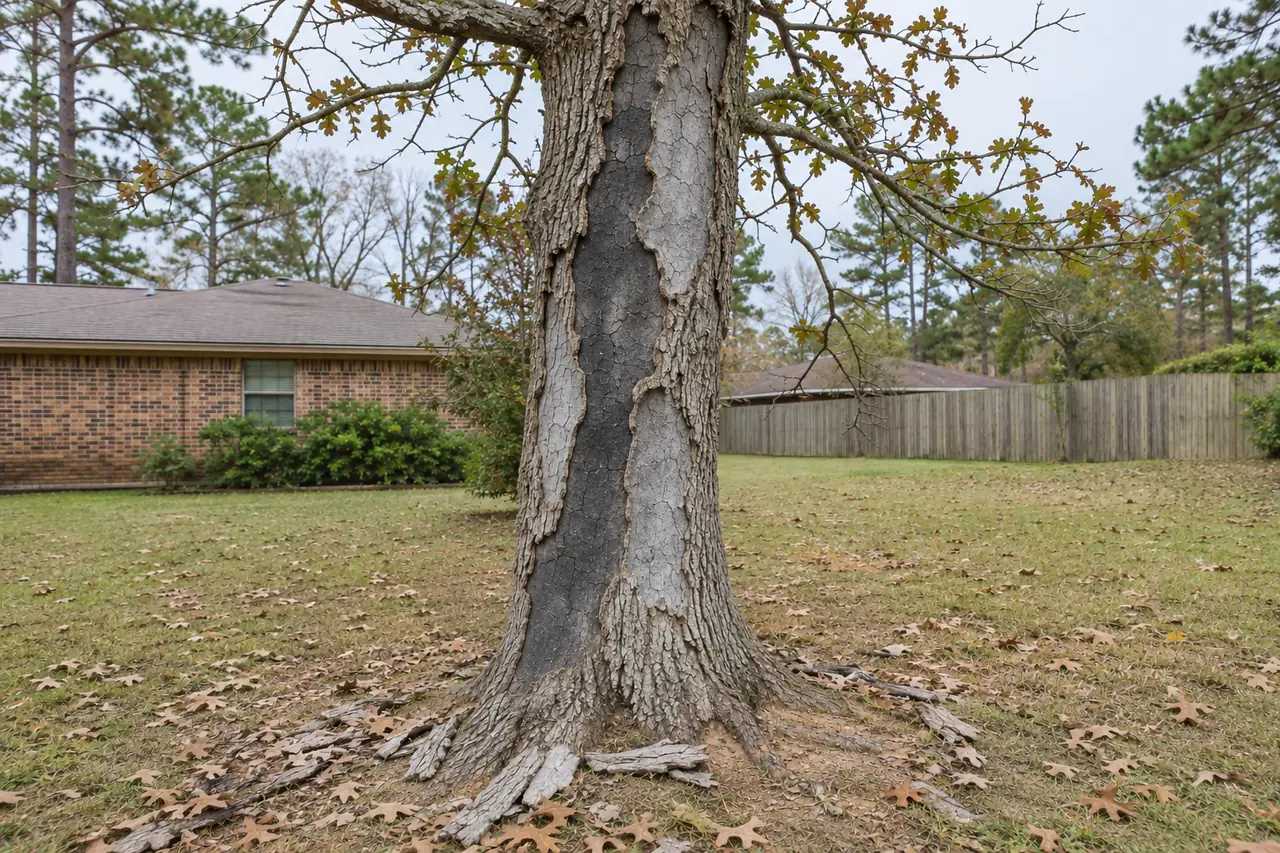
When the bark on a Kilgore post oak or water oak falls away in patches and strips to show a crusty reddish-brown or olive-green layer that later turns gray and then black, the tree has hypoxylon canker, a fungus that takes over oaks already weakened by drought, flooding, root damage or construction. Texas A&M AgriLife's plant clinic says to prune out the dead limbs when 15% of the canopy or less is infected and to consider removing the tree when more is, because the rot it causes makes the tree a danger to people and property.
Call (903) 522-5538 or send the form, and one independent local contractor will look at the oak and price pruning or removal.
What does hypoxylon canker look like?
Texas A&M AgriLife's diagnostic lab describes it in stages (Hypoxylon Fact Sheet, Part 2, checked Nov 21, 2026):
- The outer bark falls off, exposing the fungus underneath.
- Early on, the exposed patches are a crusty layer, light to dark reddish-brown or olive-green.
- Later, the surface turns gray and flakes away after 6 to 12 months, leaving dark brown to black material.
- The patches merge into long strips down the trunk and the major limbs.
- The crown thins: yellow or brown leaves, small leaves, short twig growth, dead limbs and sprouts along the trunk.
Which Kilgore trees get it?
Any oak. The plant clinic names black, blackjack, laurel, live, post, southern red, Texas red, water and white oaks (Hypoxylon Fact Sheet, Part 1, checked Nov 21, 2026). In early 2024, Texas A&M Forest Service named hypoxylon canker as one of the most threatening fungi for weakened hardwoods in East Texas (Texas A&M Forest Service, Feb. 4, 2024, checked Nov 21, 2026).
Two of the oaks most common in Kilgore yards have weak spots that make them likely candidates:
- Post oak. The U.S. Forest Service describes it growing mostly on well-drained, sandy, nutrient-poor soils, the kind Kilgore has, and notes that big post oaks "do not tolerate compaction or removal of soil in developments" (USFS Silvics, post oak, checked Nov 21, 2026). A post oak left standing beside a new slab, driveway or septic field is a stressed tree.
- Water oak. Texas A&M Forest Service's planting guide says it isn't drought tolerant and that decay can be a problem in older trees (Texas Tree Planting Guide, water oak, checked Nov 21, 2026).
Why did the oak get it now?
The fungus is an opportunist. The plant clinic says it doesn't affect healthy, vigorous trees but quickly colonizes weakened ones, and it lists the stresses: construction damage, soil compaction, drainage problems, heat, drought, flooding, insect attacks, and diseases such as oak wilt and root rots (Part 1, checked Nov 21, 2026).
East Texas has supplied most of those lately. Texas A&M Forest Service has said the droughts of 2011 and 2015 "are still oppressing the surviving trees today," on top of three straight years of hard freezes and droughts (Feb. 2024, checked Nov 21, 2026). Its 2025 report adds drought, freeze and drought again (TX FHH 2025, checked Nov 21, 2026).
How dangerous is an oak with hypoxylon?
More than it looks from the ground. The canker causes a white rot of the sapwood, which the plant clinic says compromises the tree's structure and makes it a danger to life and property (Part 1, checked Nov 21, 2026). Trees killed by it "may quickly become a hazard" (Part 3, checked Nov 21, 2026). Limbs over a roof, a driveway or a play set are the ones to deal with first.
Rotting wood also changes how the tree can be taken down. A climber may not tie into a trunk with white rot, so the contractor may bring a lift, which shows up in the price.
Should the oak be pruned or removed?
| How much of the canopy is infected | What the plant clinic advises |
|---|---|
| 15% or less | Prune out all the dead branches |
| More than 15% | Consider cutting the tree down |
Source: Texas A&M AgriLife, Hypoxylon Fact Sheet, Part 3, checked Nov 21, 2026.
The same fact sheet says diseased wood shouldn't be stored next to the trees you're keeping. That rules out stacking hypoxylon oak as firewood under the healthy oak next door. It also says the main control is preventing stress, and it recommends vertical mulching to improve soil conditions around roots, which helps both in wet spells and in drought.
Will it spread to the other oaks in the yard?
The fungus is likely already there. The plant clinic notes that it's present throughout a stand, which is why it calls destroying infected wood to stop new infections questionable (Part 3, checked Nov 21, 2026). Whether a neighboring oak shows it depends on how stressed that tree gets. Keeping heavy equipment, trenching and fill dirt off the roots of the oaks you want to keep matters more than anything done to the sick one.
Could it be oak wilt instead?
Less likely in Kilgore. Texas's 2025 forest health report places documented oak wilt in 76 counties, mostly west of I-35 between Dallas and San Antonio and across I-20 to Lubbock (TX FHH 2025, checked Nov 21, 2026). Bark falling off in strips over a gray or black crust points to hypoxylon. If you aren't sure, Texas A&M Forest Service has local foresters who can look.
See also: trimming out dead limbs and the oaks of Kilgore yards.