
Kilgore job guide
Tree Trimming in Kilgore, Texas
Short answer
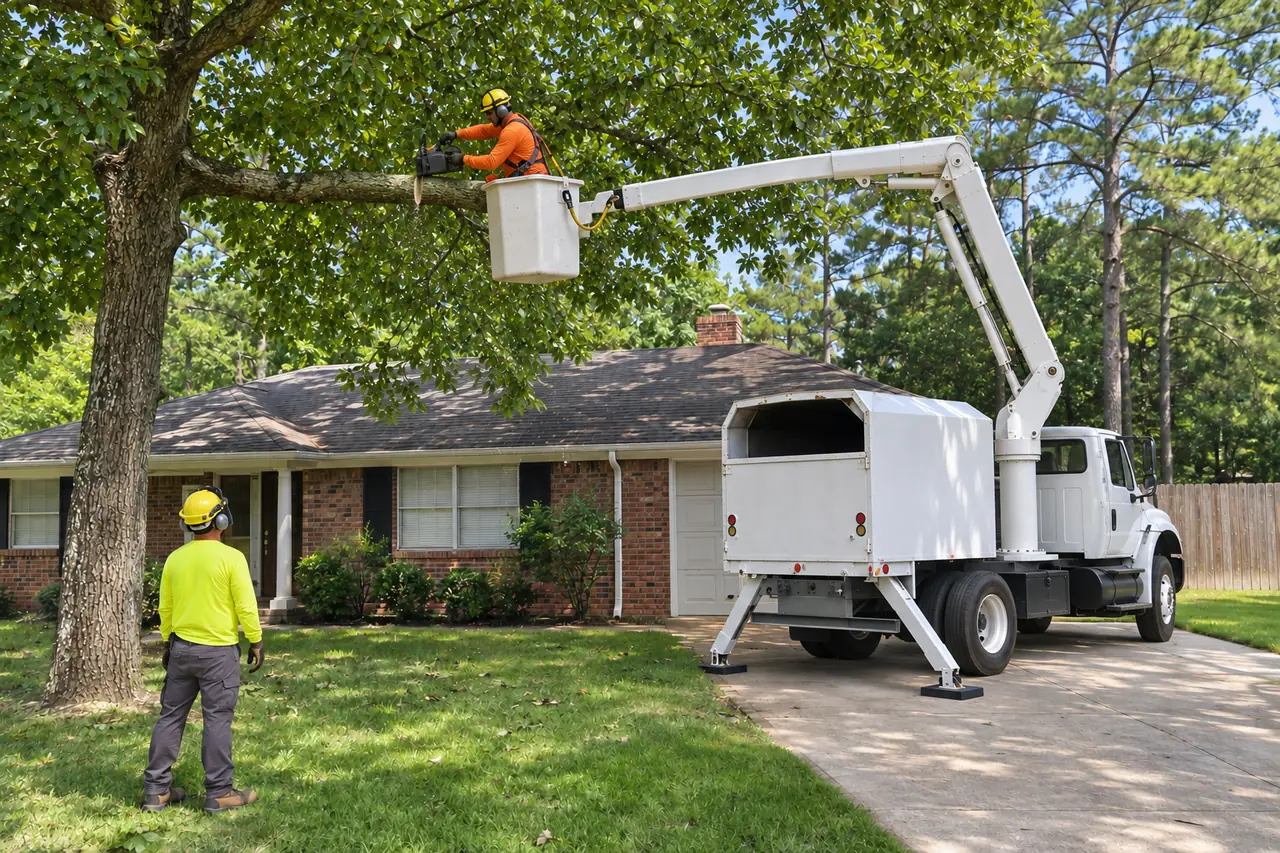
Tree trimming in Kilgore is about keeping a tree you like and taking off the parts most likely to land on something: dead limbs over the roof, oak branches grinding on shingles, low limbs over the driveway and pine limbs that already droop. Ring (903) 522-5538 or use the form; one independent contractor from the area comes out to look, tells you which limbs they would take and prices the job.
The line from the utility pole to your house is the homeowner's to keep clear in Kilgore. That job, and how it's done safely, is on the power line page.
Which limbs come off first?
Texas A&M Forest Service calls the basic job "cleaning": removing dead, dying, diseased, weakly attached and low-vigor branches (Pruning Mature Trees, Texas A&M Forest Service, checked Nov 21, 2026). In a Kilgore yard that usually lines up like this:
- Dead wood over the house, the drive and the play area. Gray, barkless limbs in a pine or an oak are dead, and dead branches head the guide's cleaning list.
- Limbs touching the roof or gutters. Wind rocks them against shingles, and leaves and needles pack the gutters.
- Weak or failing branches. Cleaning also takes out weakly attached and low-vigor branches.
- Low limbs over the driveway, the street side and the sidewalk.
- Weight and size. The guide says thinning reduces weight on heavy limbs. Reduction shrinks a tree's height or spread by cutting back to side branches at least one-third the diameter of the stem being cut.
Why do Kilgore pines snap under ice?
Ice is hard on pines. Texas A&M Forest Service's tree planting guide lists loblolly pine as susceptible to ice damage and bark beetles (Texas Tree Planting Guide, loblolly pine, checked Nov 21, 2026).
During the January 2026 winter storm, Oncor reported a quarter to half an inch of ice in many East Texas areas and more than three-quarters of an inch in spots. Its east region customer service executive said many of the big community trees are "pine and other soft-woods that are more prone to bending and snapping under the weight of ice," and warned that sagging branches can spring back up into lines as the ice melts (Oncor, Jan. 25, 2026, checked Nov 21, 2026).
Trimming can't ice-proof a pine, but taking dead limbs and long, low, heavy limbs off the side that faces the house cuts down what can fall on it. A pine whose top is already broken, or that leans after an ice storm, is a removal question rather than a trimming one.
Which cuts help an oak and which ones hurt it?
The same Forest Service guide sets out the rules a careful crew follows:
- Cut just outside the branch collar, where the limb meets the trunk. The guide says the collar holds trunk or parent-branch tissue and shouldn't be damaged or removed.
- Take heavy limbs in three cuts. An undercut 12 to 18 inches out from the trunk, a top cut that drops the limb and leaves a stub, then a final cut back to the collar. Taking the weight off first avoids tearing the bark, the guide says.
- Don't remove too much at once. The guide says generally no more than 25% of the crown should come off at one time, and less for mature trees.
- Reduce rather than top. It calls reduction "a healthy alternative to topping."
- Skip the wound paint. Research shows dressings don't reduce decay or speed closure; the guide's one exception is oak pruning where oak wilt is present.
Ask the contractor how they plan to cut and how much of the crown will come off. If the answer is "take the top out," ask about reduction instead.
Is trimming a sick oak worth it?
Sometimes. For an oak with hypoxylon canker, Texas A&M AgriLife's plant clinic says to prune out all dead branches when 15% of the canopy or less is infected, and to consider cutting the tree down when more than 15% is infected (Hypoxylon Fact Sheet, Part 3, checked Nov 21, 2026). The hypoxylon page shows what an infected limb looks like.
For pines, the main worry in a dry year is the wound itself. Texas A&M Forest Service warns that wounded pines are more open to bark beetle attack (Texas A&M Forest Service, checked Nov 21, 2026). A crew working in a drought should avoid scraping trunks and roots with equipment.
Can the crew trim around the wire to the house?
Yes, but not while it's live. SWEPCO says the service drop is the property owner's responsibility and that it will send a crew to disconnect it temporarily if you call 888-216-3523 at least two business days before the work (SWEPCO, checked Nov 21, 2026). Lines between poles are the utility's to trim. Details for both SWEPCO and the electric cooperative are on the power line page.
What does tree trimming cost?
Trimming is priced per tree, by height, how much comes off and how hard the tree is to reach. Two national sources, by height:
| Tree height | HomeGuide | LawnStarter |
|---|---|---|
| Under 30 feet | $250 to $700 | $85 to $415 |
| 30 to 60 feet | $600 to $1,200 | $215 to $790 |
| Over 60 feet | $1,000 to $2,500+ | $475 to $1,835 |
Sources: HomeGuide, tree trimming cost, and LawnStarter, tree trimming cost (updated Sept. 24, 2026), both checked Nov 21, 2026. HomeGuide lists pines at $250 to $1,600 and oaks at $450 to $1,500 per tree.
The two publishers survey differently, which is why their ranges don't match. What counts is the written price you get once the contractor has stood under your tree. The price page has removal and stump grinding figures too.
What should you point out when the contractor visits?
- Which limbs worry you and what they hang over.
- Any limb that has cracked, split or dropped bark since the last storm.
- Where the wire from the pole enters the house.
- Whether you want the brush chipped and hauled or the wood left in rounds.
- Whether the tree has lost needles or leaves out of season, which can point to beetles or canker instead of a trimming job.