
Piney Woods
Kilgore, Texas Yard Trees and the Ground They Grow In
Short answer
Most Kilgore yard trees are Piney Woods natives: loblolly and shortleaf pine, post oak, water oak and southern red oak, and sweetgum, rooted in brown sandy loam that turns to red clay anywhere from a few inches to several feet down. Each one fails in its own way, so knowing which tree you have tells you what to watch for: pines that snap under ice or die fast after beetles move in, water oaks that decay as they age, post oaks that decline after their roots are disturbed, and ash trees now facing a beetle confirmed in Rusk County, which takes in the south side of town.
If one of them is leaning, dropping limbs or changing color, call (903) 522-5538 or send the form, and one independent local contractor will come look at it.
Is it a loblolly or a shortleaf pine?
Both grow here, and both get tall enough to reach a roof from well across the yard.
| What to look at | Shortleaf pine | Loblolly pine |
|---|---|---|
| Needles | Slender and flexible, 3 to 5 inches, usually 2 to a bundle (sometimes 3) | Medium-length green needles |
| Cones | Egg-shaped, 1.5 to 2.5 inches, the smallest of the Texas pines | Large and brown, ripening in fall |
| Bark | Thick, brownish-red, in flat irregular plates with dark seams | Not described in the planting guide |
| Size and growth | About 100 feet tall, with a short oval crown | Large and fast-growing |
| Where it grows | Well-drained uplands of East Texas, most common in the hills of Northeast Texas | A wide range of sites, best with good drainage |
| Weak spots | Not listed on the identification page | Ice damage, bark beetles, heavy needle drop |
Sources: Texas A&M Forest Service, Trees of Texas, shortleaf pine, and Texas Tree Planting Guide, loblolly pine, both checked Nov 21, 2026.
For a homeowner, the difference matters less than what the two share. Both are southern yellow pines, the group Ips engraver beetles infest and kill (Texas A&M Forest Service, checked Nov 21, 2026). After the February 2021 freeze and the dry months that followed, Ips attacked weakened pines across East Texas, and the agency said death "is often measured in days and not weeks" (Nov. 2021, checked Nov 21, 2026). The signs and the timing are on the dying pines page.
What makes a post oak touchy?
Post oak leaves are easy to pick out: the rounded middle lobes sit opposite each other, which gives the leaf the look of a cross. Texas A&M AgriLife's rangeland plant guide puts it at 30 to 60 feet tall, native from Central to East Texas, including the Pineywoods (Plants of Texas Rangelands, post oak, checked Nov 21, 2026).
The U.S. Forest Service's silvics manual describes post oak as drought resistant and typical of well-drained, sandy, coarse soils low in nutrients and organic matter. The catch is the roots: large post oaks "do not tolerate compaction or removal of soil in developments." The same manual says the chestnut blight fungus causes defects and kills post oaks throughout the species' range, and that decay fungi cause cankers and rots in the stem and roots (USFS Silvics, post oak, checked Nov 21, 2026).
So a big post oak whose roots were cut or packed down when the house, the driveway or a septic field went in is one to keep an eye on. Bark peeling off in strips over a gray or black crust is hypoxylon canker, which moves into oaks already under that kind of stress.
Why do old water oaks worry tree crews?
Water oak grows fast and large, with dark green, bell-shaped leaves and a dense canopy, and it handles moist and poorly drained spots. Texas A&M Forest Service's planting guide also lists its drawbacks: it isn't drought tolerant, it drops acorns, and "decay can be a problem in older trees" (Texas Tree Planting Guide, water oak, checked Nov 21, 2026).
That combination is why an old water oak deserves a close look after a dry summer. A hollow at the base, mushrooms on the root flare, or a big limb with a cavity where it meets the trunk are reasons to have someone look before the next storm season. Southern red oak is on Texas A&M AgriLife's list of oaks that hypoxylon canker attacks, along with post and water oak (Hypoxylon Fact Sheet, Part 1, checked Nov 21, 2026).
What's the trouble with a sweetgum?
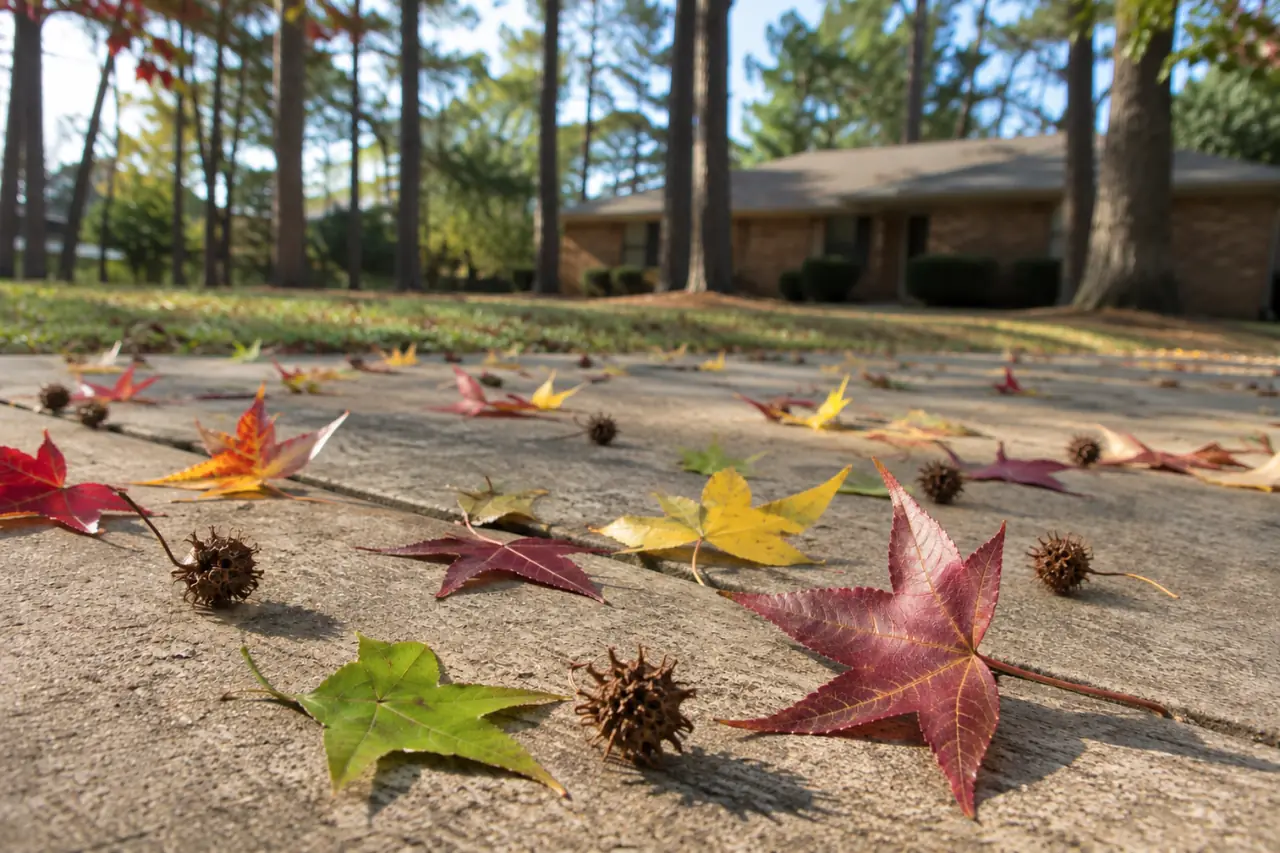
Nothing dangerous, usually, but plenty of work. The planting guide describes sweetgum as a large, fast-growing tree with star-shaped leaves, dependable fall color and "round, spiky seed balls," and lists its problems as fruit drop and surface roots. It also notes that sweetgum is sensitive to alkaline soils (Texas Tree Planting Guide, sweetgum, checked Nov 21, 2026).
The seed balls roll underfoot on driveways and sidewalks, and the surface roots can lift a walk or get in the way of a mower. Removing a healthy sweetgum is a homeowner's choice; when the question is whether to keep it, it's worth asking the contractor whether raising the canopy or thinning it would solve the problem instead.
Is an ash tree in Kilgore at risk?
Increasingly, yes. Emerald ash borer, an invasive beetle first found in Texas in Harrison County in 2016, had been confirmed in 40 Texas counties as of June 2026. The list includes Rusk County, where the south side of Kilgore sits, along with Upshur and Harrison counties to the north and east. Gregg County wasn't on it (Texas A&M Forest Service, Emerald Ash Borer, checked Nov 21, 2026).
The agency says that once an ash is infested it's likely to die, and that where the beetle is well established it can kill an ash within a year of the first infestation. An ash near the house that starts losing its upper crown is one to have looked at soon, while it can still be climbed.
What's in the ground under these trees?
Sand on top, clay underneath, in varying amounts. The Kirvin series that the USDA maps on this part of the East Texas Coastal Plain is typical: a brown very fine sandy loam surface with some ironstone gravel, and red clay starting anywhere from about 3 to 20 inches down. The USDA's description says these soils are used mainly for pasture and woodland, with forests of shortleaf, slash and loblolly pine, red oak, sweetgum and other hardwoods (USDA official series description, Kirvin, checked Nov 21, 2026). Other mapped soils, like Darco, keep deep sand for several feet before the clay.
That mix shows up in every tree job. It decides whether a stump hole holds its shape or slumps in, how firm the ground is under a loader after rain, and how far a crew can drive onto a lawn. The stump grinding page covers the soils in more detail.
Planting something to replace it?
Pick the spot for the tree's full size, not its nursery size. SWEPCO's planting guidance keeps large trees at least 40 feet from power lines (SWEPCO, checked Nov 21, 2026), and loblolly pine, water oak and sweetgum are all listed as large in the state planting guide. Kilgore's Development Code sends the projects it covers to Texas A&M Forest Service's Texas Tree Selector for new trees, which is a good place for a homeowner to start too (Art. III, Div. 3, Sec. 3(d), checked Nov 21, 2026). The tree rules page explains which projects that code section covers.