
Utility lines
Trees and Power Lines in Kilgore, Texas
Short answer
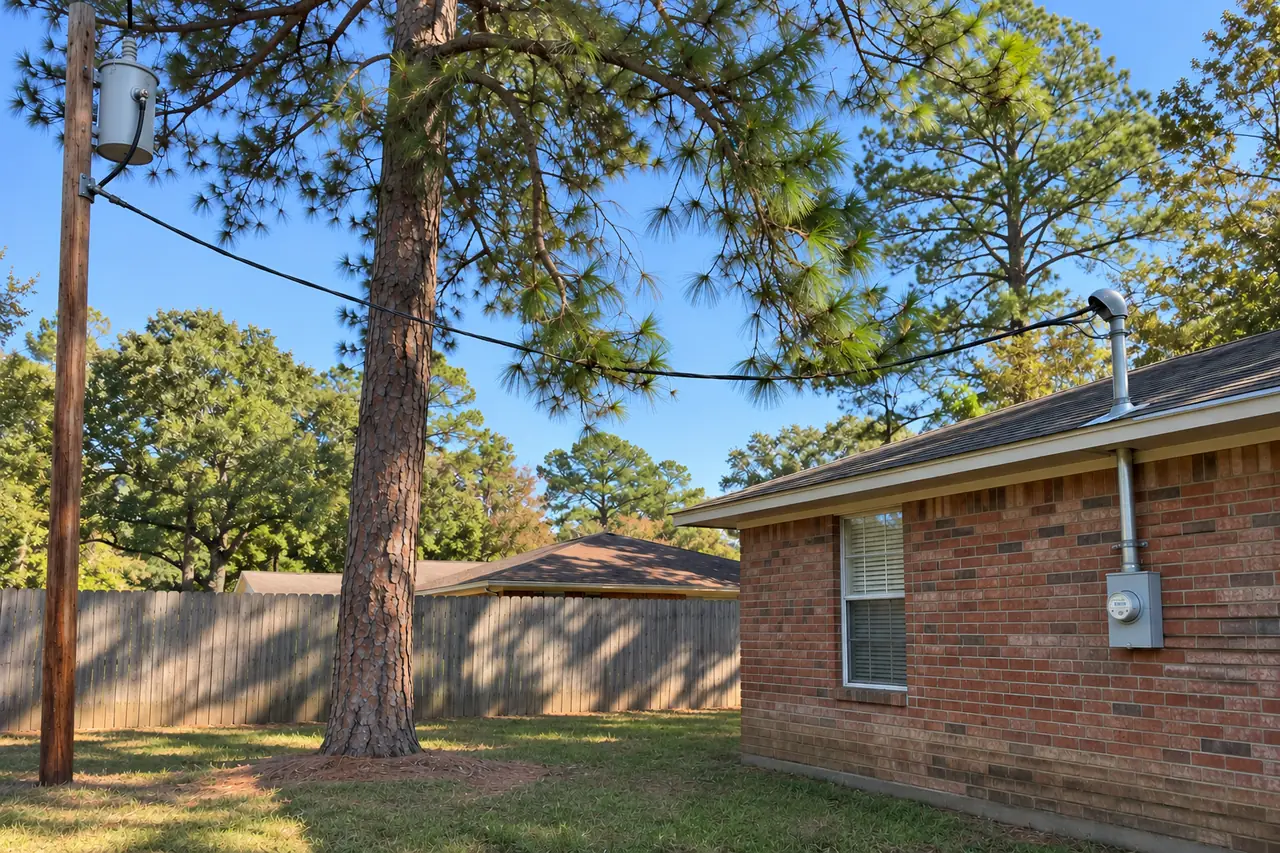
In Kilgore the electric utility trims trees along the lines that run from pole to pole, but the service drop, the short span of wire feeding the house itself, is the homeowner's to keep clear. SWEPCO and Rusk County Electric Cooperative both say they don't trim around service drops and will disconnect the line on request so the limbs can be cut safely. Separately, for lines carrying more than 600 volts, Texas law bars anyone from working where they or their tools could come within six feet until safety arrangements are made with the line's operator.
Call (903) 522-5538 or send the form for the trimming itself: one independent local contractor looks at the tree, the line and the clearance needed, and prices the work.
Which utility runs the lines at your Kilgore address?
- SWEPCO (Southwestern Electric Power Company, part of AEP) serves Kilgore. It has funded efficiency projects at Kilgore's Christus Memorial Hospital and Kilgore ISD (SWEPCO, Sept. 10, 2025), and its storm updates list Kilgore among the Texas areas it restores (SWEPCO update, June 2024, via Shelby County Today), both checked Nov 21, 2026. SWEPCO isn't part of the ERCOT grid (The Texas Tribune, June 18, 2023, checked Nov 21, 2026).
- Rusk County Electric Cooperative is headquartered in Henderson and serves areas in Rusk, Gregg, Panola, Nacogdoches and Shelby counties (RCEC), over more than 3,600 miles of line (About RCEC), both checked Nov 21, 2026. Rural addresses around Kilgore may be on its lines.
- Upshur Rural Electric Cooperative, based in Gilmer (Jan. 17, 2024 release), serves a ten-county area of East Texas (URECC), and the co-op's registered slogan names Gregg and Rusk among those counties (U.S. trademark record), all checked Nov 21, 2026. It's another possible utility for a rural address.
- Oncor lists Overton among its towns, but not Kilgore (Oncor, checked Nov 21, 2026).
This list may not cover every address. Your electric bill names your utility, and that's the company to call about a tree on a line.
What does SWEPCO trim, and what does it leave to you?
SWEPCO says it only trims or removes trees growing too close to lines that run from pole to pole. It doesn't trim trees threatening your service drop: "That is the responsibility of the property owner." If you're having those limbs cut, call 888-216-3523 at least two business days ahead and SWEPCO can send a crew to temporarily disconnect the service line. It also says you should never try to trim or remove trees near power lines yourself (SWEPCO, report a tree problem, checked Nov 21, 2026).
On the lines it does maintain, SWEPCO describes its forestry program this way (SWEPCO tree trimming process, Sept. 1, 2022, checked Nov 21, 2026):
- About 90 crews work daily across its territory.
- Forestry clears the primary, secondary and neutral wires. It doesn't maintain clearance on communication lines, usually the lowest wires on the pole.
- Crews often cut back to a side branch and typically take off about three years' worth of growth per visit.
- Equipment includes all-terrain trimming machines, mulchers, bucket trucks and climbers, and herbicide is used to keep vines off poles.
- Customers are told by door cards, in person if they're home, and by automated notice when an outage is planned.
What does Rusk County Electric Cooperative trim?
The co-op says it prunes trees near its lines year-round on a systematic rotation, and that it has the right, but not the obligation, to prune only the parts that may contact lines. It doesn't trim trees near service drops from pole to house, and members can request a temporary disconnect to trim safely. Members are responsible for removing the debris. To report a dead tree that could fall on a line, give the co-op a daytime phone number and a description of the tree; the number it lists is (903) 657-4571 (RCEC right-of-way service, checked Nov 21, 2026).
What does Texas law say about working near lines?
Chapter 752 of the Texas Health and Safety Code deals with overhead lines carrying more than 600 volts, which it calls high voltage (§752.001, checked Nov 21, 2026). Under §752.004, work isn't allowed anywhere a person, or a tool, machine or material in their hands, might get within six feet of one of those lines, unless the hazard has first been guarded against the way §752.003 lays out (§752.004, checked Nov 21, 2026). That section calls for telling the line's operator at least 48 hours ahead. The work can't start until the two sides agree on a safety arrangement, such as shutting off and grounding the line, moving or raising it for a while, or putting up barriers, and the person responsible for the work pays the operator's actual cost of it (§752.003, checked Nov 21, 2026).
A house doesn't run on high voltage. OSHA explains that a transformer on the pole or a pad steps distribution power down to 120/240 volts for homes, and a service drop carries it to the house (OSHA, distribution systems, checked Nov 21, 2026). So in a neighborhood, the lines over 600 volts are usually the pole-to-pole lines, not the drop to the house. For the service drop, the rule comes from the utilities instead: SWEPCO and the co-op both say to call for a temporary disconnect before limbs near it are cut (see above). That leaves limbs near the pole-to-pole lines to the utility, and limbs on the service drop waiting for the disconnect.
How much do trees on lines cost Kilgore in a storm?
A lot of dark days. After the May 28, 2017 storm, which put an EF1 tornado through Longview and straight-line winds across the region, the National Weather Service reported that AEP-SWEPCO ranked the event fourth for it by customers out at the peak, and noted outages lasting days because trees fell on lines (NWS Shreveport, checked Nov 21, 2026). In the June 2023 storms, SWEPCO said tree and structure damage forced 50 of its transmission lines out of service (June 18, 2023), and at 5 p.m. on June 21 it still had 15,481 customers out in Longview and the surrounding service areas (June 21, 2023), both checked Nov 21, 2026. More on the storm page.
Where should a new tree go relative to lines?
SWEPCO's planting guidance puts small trees at least 20 feet from power lines, medium trees at least 30 feet and large trees at least 40 feet (SWEPCO, checked Nov 21, 2026). A loblolly or a water oak is a large tree. If you're replacing a pine that came down near the street, pick the spot with the mature size in mind.
Before the contractor trims near a line
- Find the line that feeds the house and note which limbs touch or hang over it.
- Call the utility for the temporary disconnect at least two business days ahead, and plan the trimming for that window.
- Point out any cable or phone wires too; SWEPCO's forestry doesn't clear those.
- Ask the contractor what happens to the brush. With the co-op, debris from member trimming is the member's to remove.
See also tree trimming in Kilgore and the tree rules page.